
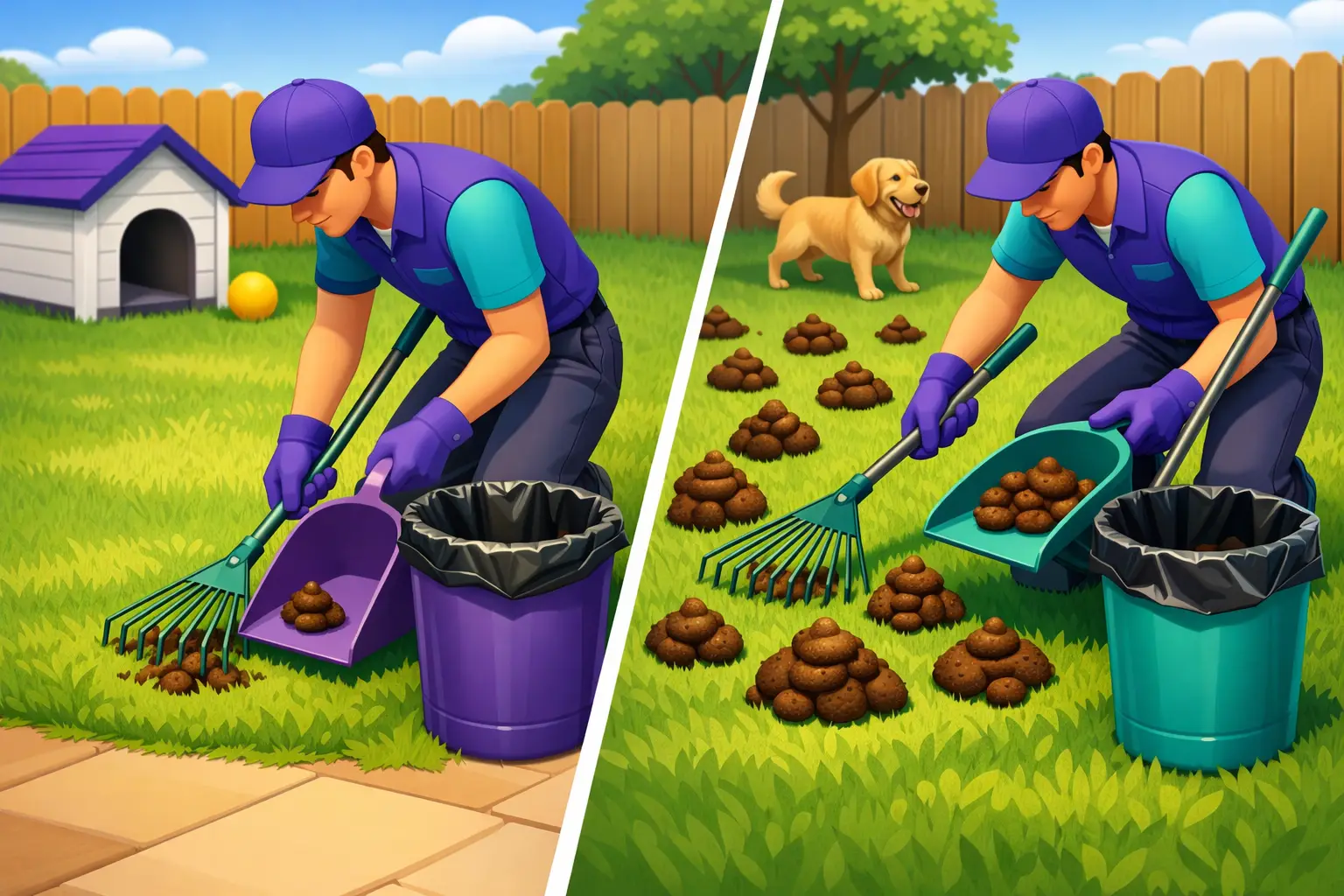
If your yard seems fine on Monday and looks questionable by Friday, you’re already asking the right question: weekly vs biweekly poop scooping. The best schedule is not about perfection. It’s about how fast waste builds up, how often your yard gets used, and how much mess you want sitting outside between visits.
For most dog owners, the choice comes down to two things: how clean you want the space to stay and how much catch-up you’re willing to tolerate. A weekly schedule keeps things consistently under control. A biweekly schedule can work, but only when the yard, dog count, and usage level make sense.
Weekly vs biweekly poop scooping: what really changes?
The biggest difference is not just frequency. It’s buildup.
With weekly service, waste gets removed before it really piles up. Your lawn stays more usable, odors stay lower, and there’s less chance someone steps in something after a quick run outside. If you have kids, host often, or let your dog roam the yard multiple times a day, that consistency matters.
With biweekly service, there’s naturally more accumulation between visits. That can still be perfectly workable for some households, especially if you have one dog, a larger yard, and lower daily traffic outside. But the yard will not feel as consistently clean from one day to the next. The day before service tends to feel very different from the day after service.
That’s the real trade-off. Weekly gives you steadier results. Biweekly saves money upfront, but allows more mess to sit longer.
When weekly poop scooping makes the most sense
Weekly service is usually the better fit for homes where the yard gets used like an extra room. If your dog is out there several times a day, if children play outside, or if you simply want to avoid even thinking about pet waste, weekly is the easier answer.
It also makes sense for multi-dog homes. Two dogs do not create a little more waste. They often create enough extra buildup that a biweekly plan starts feeling long before the next visit arrives. The same goes for smaller yards, where there’s less space for waste to spread out and more chance that it affects the whole area fast.
Warm weather is another factor. In spring and summer, odors show up quicker, flies become more noticeable, and a neglected yard feels less inviting. Weekly service helps keep outdoor space usable during the months when you actually want to be outside.
For many busy households, weekly is not just cleaner. It’s simpler. There’s less mental load, less need to monitor the yard, and less chance of needing an extra cleanup because things got out of hand.
Weekly service is often best for:
Single-family homes with active yards, families with kids, multi-dog households, and anyone who wants a consistently clean space without much fluctuation between visits.
When biweekly poop scooping can work well
Biweekly service is not a bad option. It just needs the right conditions.
If you have one dog, a decent-sized yard, and lower overall yard use, every two weeks may be enough to keep things manageable. Some dogs also have routines that make waste easier to predict and contain in certain areas, which can make less frequent service more realistic.
Biweekly can also be a practical entry point for homeowners who want help but are still figuring out what schedule fits their budget and lifestyle. It offers relief from doing the job yourself, while still reducing the amount of waste sitting out long term compared with occasional DIY cleanup.
That said, biweekly service works best when your expectations match the schedule. If you want the yard to look and feel clean every day, biweekly may leave too much in between visits. If your goal is mainly staying ahead of major buildup and avoiding a full weekend cleanup, it can be a solid fit.
Cost vs convenience
This is where many people hesitate, and fairly enough. Biweekly service usually costs less than weekly service, so it can look like the obvious value. But the better value depends on what problem you’re trying to solve.
If your main goal is lowering your monthly cost while still getting regular help, biweekly often makes sense. If your goal is keeping the lawn reliably clean, reducing odor, and making the yard ready to use at any time, weekly usually delivers more of what you actually want.
There’s also the question of effort between visits. Some homeowners choose biweekly service, then end up doing spot pickups themselves because the buildup becomes annoying before the next appointment. At that point, the savings may not feel as worthwhile.
A good service plan should remove stress, not create a situation where you’re half-managing the problem on your own.
How dog count changes the answer
Dog count is one of the clearest indicators in the weekly vs biweekly poop scooping decision.
One dog gives you more flexibility. Depending on the size of the dog, the size of the yard, and how often the space is used, biweekly may be enough.
Two dogs push many homes into weekly territory. Waste adds up faster than most people expect, especially when dogs use the same general area.
Three or more dogs usually call for weekly service at minimum. At that point, the issue is not just appearance. It’s how quickly the yard becomes unpleasant to walk through, smell, and use.
The smaller the property, the less room there is for error. A large yard can absorb some delay visually. A compact city or suburban yard usually cannot.
Yard use matters as much as yard size
People often focus on square footage, but usage matters just as much.
A medium-size yard that gets used all day by dogs and kids may need more frequent service than a larger yard that sees limited traffic. If your family grills outside, uses a playset, gardens, or just lets the dog out often, a cleaner baseline matters more.
Property managers should think the same way. Shared outdoor spaces, pet relief areas, and dog-friendly common spaces benefit from more consistent service because more people interact with them. Once residents or visitors notice waste and odor, satisfaction drops fast.
In those cases, weekly service often supports the experience people expect from the property. Biweekly may be workable in lower-traffic areas, but high-visibility spaces usually benefit from tighter scheduling.
Seasonal changes can shift your ideal schedule
Your best schedule does not have to stay the same all year.
Spring and summer often justify weekly service because lawns are in heavier use and warmer temperatures make waste harder to ignore. Fall can go either way depending on yard use. Winter sometimes gives homeowners more flexibility, especially when outdoor activity drops.
That said, colder weather does not make waste disappear. It just makes some people less motivated to deal with it. Then the thaw comes, and the yard becomes a bigger project than expected.
Some households do well with a steady year-round schedule because it keeps things simple. Others prefer to adjust based on season, dog activity, and how much they actually use the yard.
So which schedule should you choose?
If you want the cleanest, easiest, most reliable result, weekly is the safer choice. It keeps buildup low, supports a more usable yard, and cuts down on odor and surprises.
If you have one dog, lighter yard use, and a little more tolerance for buildup between visits, biweekly can absolutely work. It’s a practical option for the right setup.
A simple way to decide is this: if two weeks of waste in your yard sounds annoying, weekly is probably your answer. If two weeks sounds manageable and your yard conditions support it, biweekly may be enough.
For homeowners and property managers around Greater Philadelphia, the right schedule usually comes down to how you want the space to feel on an ordinary day, not just right after a cleanup. Clean Lawns. Happy Dogs. starts with choosing a plan that matches real life, so you can stop thinking about the mess and get back to using the yard.
Ready to reclaim your yard and peace of mind?
Contact Us for a free quote or visit our FAQ for more information.
Poop Scoop Protocol
Clean Lawns. Happy Dogs.
info@PoopScoopProtocol.com
(267) 667-6673